When Antibiotics Miss the Mark
She visited 5 doctors. None found it. Tami Burdick on what happens when lab methods fail and patients are forced to become their own researchers.

In this conversation
- Why negative cultures don't mean no infection — and how clinicians are misled by false negatives
- The 80% problem: most U.S. counties lack an infectious disease specialist
- How trial-and-error prescribing costs patients months, tissue, and trust
- Why patients are turning to AI before their doctors do
- What "super doctors" look like in the age of clinical decision support
A conversation with Tami Burdick, Patient Advocate & Author
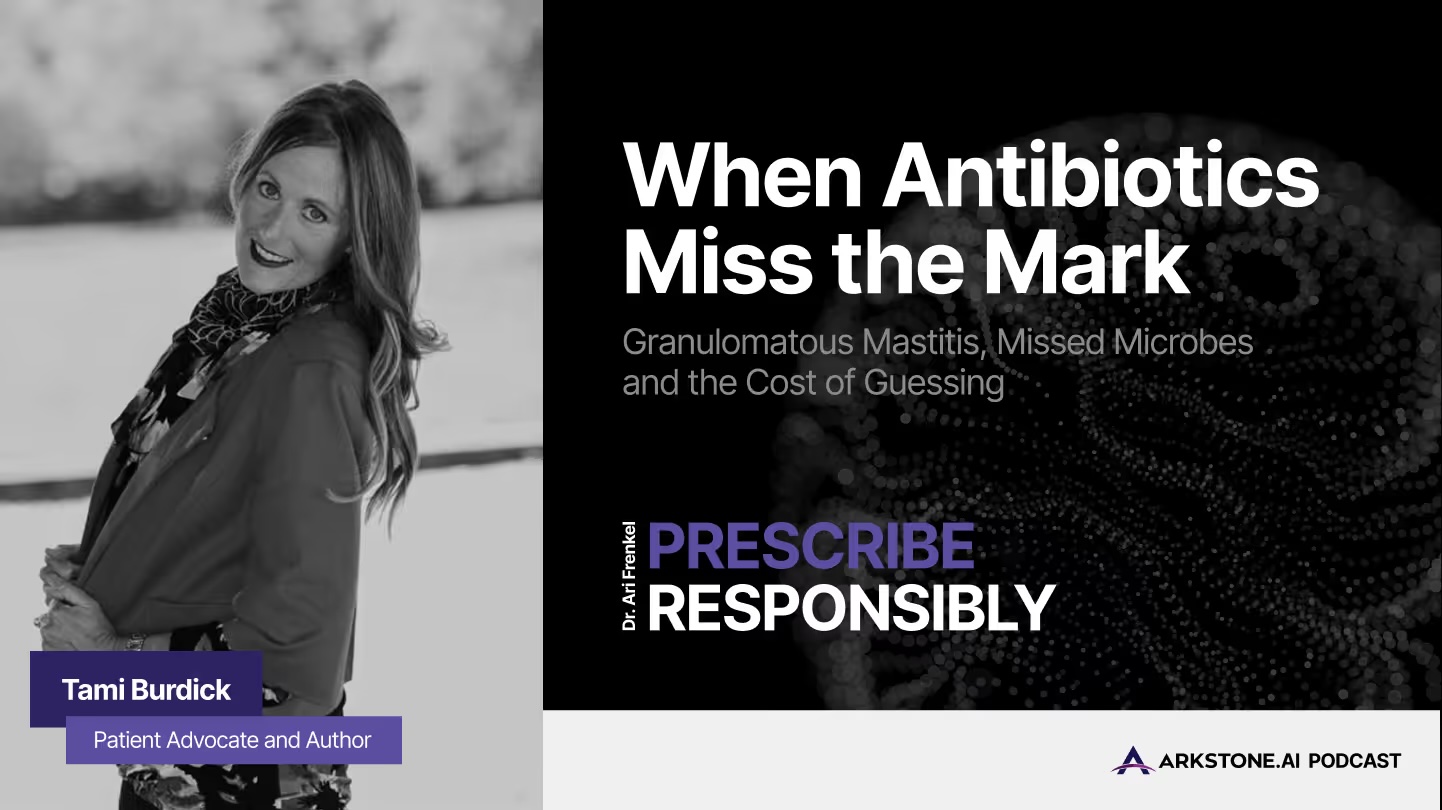
In this episode, Dr. Ari Frenkel speaks with Tami Burdick, a patient advocate and author of Diagnosis Detective: Curing Granulomatous Mastitis, about her harrowing journey that left her searching for answers on her own.
Dr. Ari Frenkel: Today's episode takes a slightly different but incredibly important angle on infectious disease. Rather than focusing solely on what clinicians see, we're going to talk about what patients experience when infections are poorly understood, organisms go undetected, and antibiotics become a trial-and-error process. I'm joined by Tami Burdick, a patient advocate with firsthand experience navigating granulomatous mastitis. Tami, could you tell us a little bit about yourself?
Tami Burdick: I am a survivor advocate and author of the book Diagnosis Detective: Curing Granulomatous Mastitis. I'm also a business consultant and career coach.
Dr. Ari Frenkel: How many doctors did you visit before a diagnosis was even made?
Tami Burdick: Doctor number one was my PCP. Doctor number two was the radiologist who performed the core needle biopsy. Doctor number three was my surgical breast oncologist. Doctor number four was the infectious disease specialist. Doctor number five was the functional medicine practitioner. My PCP called and said she'd like me to schedule an appointment with a surgical breast oncologist, and I actually thought I was going to get a breast cancer diagnosis — my mammogram was BI-RADS 5, highly suspicious for breast cancer.
Dr. Ari Frenkel: Before there was a formal diagnosis, emotionally, what was going through your mind?
Tami Burdick: I will never forget this conversation with my radiologist. I just flat out said, "I'm expecting and prepared for a breast cancer diagnosis." He responded: "While this very well could be cancer, I'm not thinking that's what this is. But whatever this is, it's chronically inflamed, and that's what you need to figure out. Why?"
That conversation was my mission and my motivation. It may have taken seven months, but eventually we figured everything out — the organism, the best course of treatment, and even took it an Erin Brockovich-like step and figured out where I contracted the bacteria: contaminated public water.
Dr. Ari Frenkel: How were you able to determine the source?
Tami Burdick: Corynebacterium kroppenstedtii is now more commonly associated with an environmental origin — water, sewer, and soil. We traced it back to a business trip to Connecticut. A gentleman on the same trip contracted an infection through his ankle. My county tested my local water — it was negative. Given all that evidence, the Connecticut well water had to be the source.
Dr. Ari Frenkel: Were they able to isolate the organism in the other gentleman's case?
Tami Burdick: No. And that's the problem. These Gram stains and cultures often fail to detect this opportunistic microorganism. It doesn't always grow in a culture. It's not always seen on a Gram stain.
Dr. Ari Frenkel: Did they use NGS or PCR to detect the organism in your case?
Tami Burdick: I discussed in my book the two tests we used — one to identify the Corynebacterium kroppenstedtii, and the other post-surgery to confirm there wasn't any residual infection. The post-surgery tests had to be sent out to the Mayo Clinic.
Dr. Ari Frenkel: How did you find a lab that could do this kind of testing? Patients often don't even know these labs exist.
Tami Burdick: In my research, I discovered the pathology tests. My surgical breast oncologist was very open-minded. I said, "There is this specific test that could help us detect something we've potentially missed." She was like, "I'm totally okay with giving this a run." But it's not really the patient's responsibility to hunt down labs and see what's available.
My doctor included in my book: "Due to her high clinical load, she just didn't have the time available to do the research that I did that ultimately led us to getting the answers."
Dr. Ari Frenkel: At what point did you realize the antibiotics weren't working?
Tami Burdick: We started with minocycline and there was no improvement from a clinical perspective. My surgical breast oncologist doesn't typically recommend steroids for GM because they can temporarily provide symptom relief, and then once the patient tapers off, the symptoms return. It's a false sense of the disease getting resolved. Once we identified the causative organism, I was put on doxycycline.
The trial-and-error approach can lead to more damage — additional abscesses, unnecessary surgeries, even mastectomy. In worst-case scenarios, unresolved GM could increase breast cancer risk because of unresolved chronic inflammation.
Dr. Ari Frenkel: Were the long-term consequences of repeated antibiotic exposure discussed with you?
Tami Burdick: Not necessarily by my healthcare practitioners. Pharmacists probably do a better job with this. It drives me crazy how easy doctors will prescribe antibiotics without concrete diagnoses. For ear infections, 40 to 70% are caused by viruses, yet doctors are quick to prescribe antibiotics. Why can't we take a little more time to test? I wish we would use more tools and resources so we can get a more definitive diagnosis.
Dr. Ari Frenkel: Do you think AI could play a role in cases like yours?
Tami Burdick: Absolutely. There's probably going to be a lot of patients who go to AI, run their symptoms, and then go to their practitioner with data. It might give more validity to their test requests.
Dr. Ari Frenkel: The information is no longer owned by medical professionals. Patients are advocating for themselves — running symptoms through AI, uploading lab results, getting interpretations. Clinicians who see AI as a tool to enhance what they provide to their patients are going to really succeed. They can become super doctors, getting differential diagnoses they may have never thought of.
Dr. Ari Frenkel: Tami, thank you so much for sharing your story. We've touched on so many important issues — diagnostics, antimicrobial resistance, the failure to act in a timely fashion, and finding the source of infection. Your story highlights a critical truth: we have a systemic problem with how infectious diseases are understood and managed. To our listeners — responsible prescribing starts with asking better questions. Antibiotics are not a harmless placeholder.
🎧 Listen to the full episode on Spotify, Apple Podcasts, and YouTube.
This content is for educational purposes only and does not constitute medical advice.